
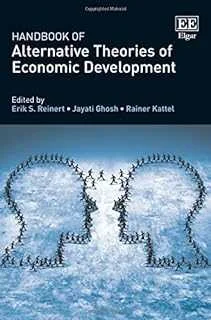
Description
Edited by Reinert Erik S.; Edited by Ghosh Jayati; Edited by Kattel Rainer
Short /annotation
The Handbook of Alternative Theories of Economic Development explores the theories and approaches which, over a prolonged period of time, have existed as viable alternatives to today’s mainstream and neo-classical tenets.
Short /annotation
The Handbook of Alternative Theories of Economic Development explores the theories and approaches which, over a prolonged period of time, have existed as viable alternatives to today’s mainstream and neo-classical tenets.
The Handbook of Alternative Theories of Economic Development explores the theories and approaches which, over a prolonged period of time, have existed as viable alternatives to today?s mainstream and neo-classical tenets. With a total of 40 specially commissioned chapters, written by the foremost authorities in their respective fields, this volume represents a landmark in the field of economic development. It elucidates the richness of the alternative and sometimes misunderstood ideas which, in different historical contexts, have proved to be vital to the improvement of the human condition.
The subject matter is approached from several complementary perspectives. From a historical angle, the Handbook charts the mercantilist and cameralist theories that emerged from the Renaissance and developed further during the Enlightenment. From a geographical angle, it includes chapters on African, Chinese, Indian, and Muslim approaches to economic development. Different schools are also explored and discussed including nineteenth century US development theory, Marxist, Schumpeterian, Latin American structuralism, regulation theory and world systems theories of development. In addition, the Handbook has chapters on important events and institutions including The League of Nations, The Havana Charter, and UNCTAD, as well as on particularly influential development economists. Contemporary topics such as the role of finance, feminism, the agrarian issue, and ecology and the environment are also covered in depth.
This comprehensive Handbook offers an unrivalled review and analysis of alternative and heterodox theories of economic development. It should be read by all serious scholars, teachers and students of development studies, and indeed anyone interested in alternatives to development orthodoxy.
Contributors: M. Alacevich, R. Arocena, J.G. Backhaus, E.B. Barbier, R. Bielschowsky, C.N. Biltoft, R. Boyer, L. Burlamaqui, C.P. Chandrasekhar, M. Cimoli, A.M. Daastøl, G. Derluguian, W. Drechsler, S. Endresen, M.S. Erkek, M.S. Floro, J. Ghosh, J.-C. Graz, J.P. Hochard, I. Ianos, P. Jha, A. Kadri, R. Kattel, J.A. Kregel, B.-Å. Lundvall, A.C. Macedo e Silva, J.A. Mathews, L. Mjøset, S. Moyo, R.R. Nelson, G. Omkarnath, E. Özveren, J.G. Palma, P. Patnaik, G. Porcile, E.S. Reinert, S.A. Reinert, P.R. Rössner, A. Saltelli, M. Shafaeddin, A. Singh, I.G. Shivji, J. Sutz, Y. Tandon, E. Thurbon, F. Tregenna, H.S. Ünal, L. Weiss, T. Xu, P. Yeros, X. Zhao
Table of contents
Contents:IntroductionErik S. Reinert, Rainer Kattel and Jayati GhoshPART I DEVELOPMENT THINKING ACROSS HISTORY AND GEOGRAPHY1. Giovanni Botero (1588) and Antonio Serra (1613): Italy and The Birth of Development EconomicsErik S. Reinert2. Economic Emulation and the Politics of International Trade in Early Modern EuropeSophus A. Reinert3. Cameralism and the German Tradition of Development EconomicsErik S. Reinert and Philipp R. Rössner4. Friedrich List: The International Dynamics of MindpowerArno Mong Daastøl5. Kathedersozialismus and the German Historical SchoolWolfgang Drechsler6. Chinese Development ThinkingTing Xu7. The Economic Cycle of Imperial China and Its DevelopmentXuan Zhao8. Islam and Capitalism: Military Routs, not Formal Institutions Ali Kadri9. Unity and Diversi


Reviews
There are no reviews yet.